
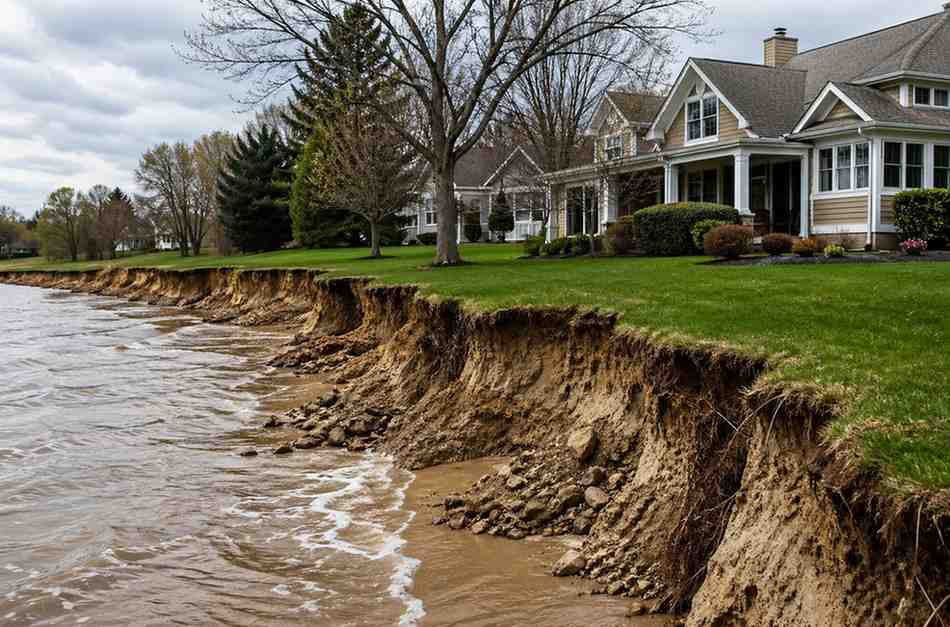
Soil loss rarely announces itself. By the time erosion is visible — in exposed roots, collapsing slopes, or sediment pooling at the base of a grade — the process has usually been underway long enough that the damage is more extensive than the surface evidence suggests.
What Causes Erosion and Why Does It Accelerate
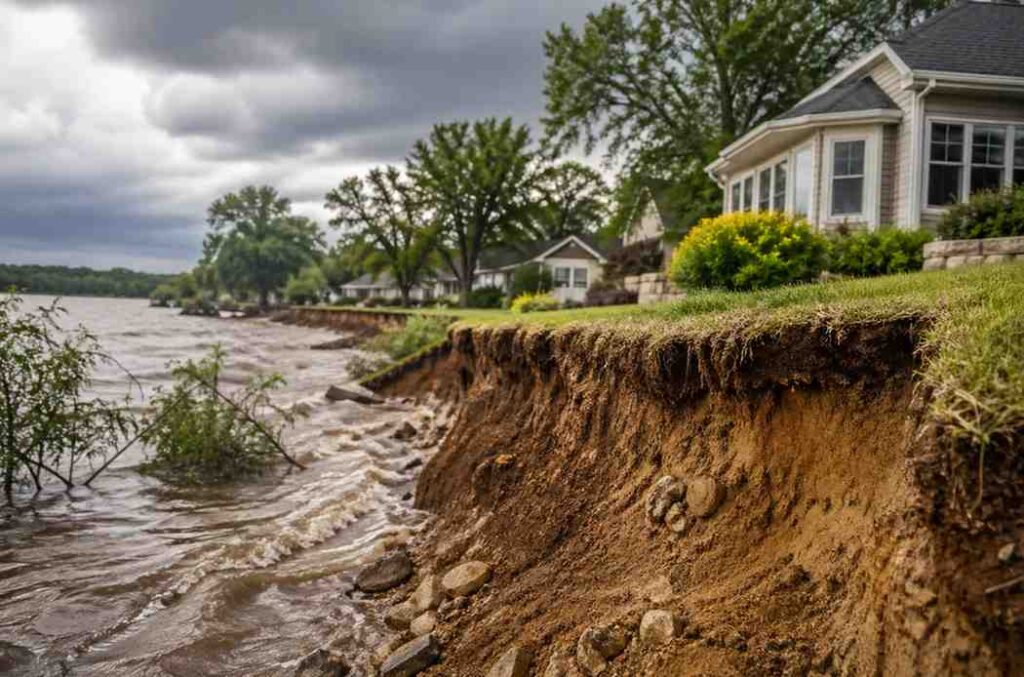
Water as the Primary Driver
Rainfall and runoff are responsible for the majority of erosion on residential and commercial properties. When rain strikes bare soil, the impact dislodges particles that moving water then carries downslope. The volume and velocity of that water determine how much soil moves — and both increase as the slope steepens, the ground cover thins, and the soil’s ability to absorb water is reduced by compaction or saturation.
Wind Erosion on Exposed Sites
Wind erosion is less common than water erosion but significant on exposed sites — particularly in arid or semi-arid environments where vegetation is sparse, and soil moisture is low. Fine, dry soil particles are the most vulnerable to wind displacement, and once the surface layer is disturbed, the underlying soil becomes progressively more exposed to subsequent wind events.
Construction and Disturbance
Construction activity is one of the most significant accelerators of erosion. Grading removes the vegetative cover and root systems that hold soil in place, leaving bare, disturbed ground exposed to rainfall and runoff before new vegetation has time to establish. Slopes created during grading are particularly vulnerable — steeper than natural grades and stripped of the organic matter that improves soil cohesion and water absorption.
Erosion Control Methods and How They Work
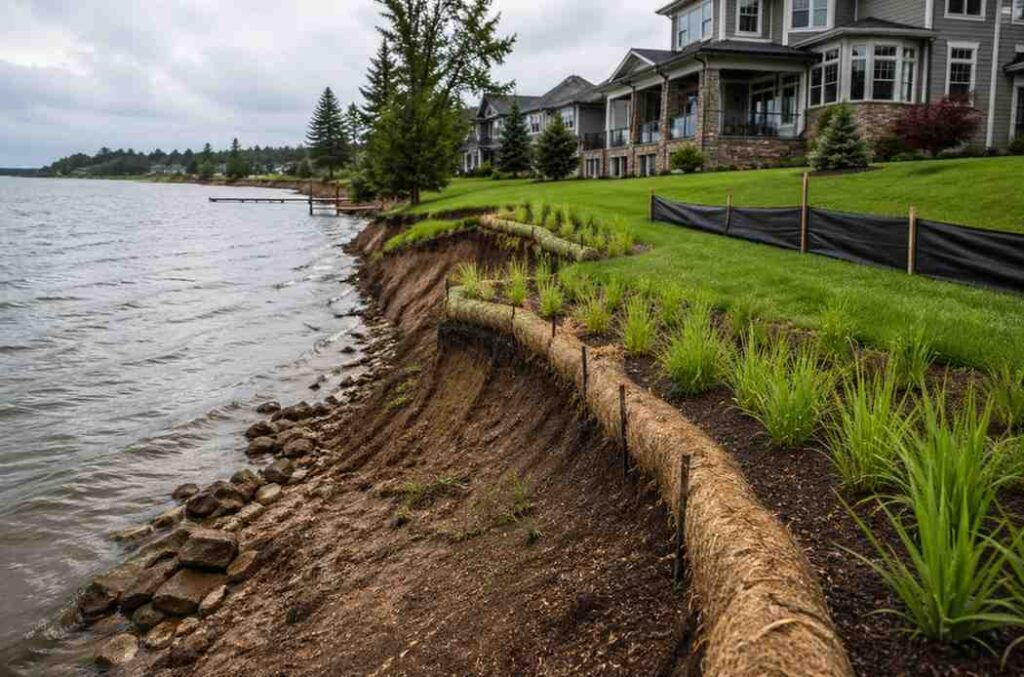
Vegetation and Ground Cover
Established vegetation is the most effective long-term erosion control available. Root systems bind soil particles together, reduce the impact of rainfall at the surface, and improve the soil’s capacity to absorb water rather than allowing it to run off. The challenge is the establishment window — newly seeded areas are vulnerable until root systems develop enough to provide meaningful protection.
Temporary ground cover — erosion control blankets, straw mulch, and hydraulic mulch applications — bridges that window by protecting bare soil from rainfall impact and reducing surface runoff velocity while vegetation establishes. The right temporary cover depends on the slope gradient, the expected rainfall intensity, and how quickly the permanent vegetation is likely to establish under the site’s conditions.
Silt Fences and Sediment Controls
Silt fences and sediment basins capture soil that’s already moving rather than preventing it from moving in the first place. They’re most useful at the perimeter of disturbed areas — catching sediment before it leaves the site and enters drainage systems, waterways, or neighboring properties. Properly installed silt fences are staked at regular intervals, trenched into the ground at the base, and maintained throughout the construction or disturbance period to remain effective.
Retaining Walls and Structural Controls
Retaining walls address erosion by changing the geometry of a slope — replacing a continuous grade with a series of level terraces that reduce the velocity of surface runoff and the distance soil particles travel when dislodged. They’re most appropriate where slope grades are too steep for vegetation alone to stabilize, or where erosion has already progressed to the point where structural intervention is needed before revegetation can succeed.
Wall material — concrete block, natural stone, timber, or gabion — affects both longevity and drainage performance. A retaining wall that doesn’t drain correctly builds up hydrostatic pressure behind it that eventually causes structural failure, regardless of how well the wall was built. Drainage design is as important as the wall construction itself.
Riprap and Slope Armoring
Riprap — large, angular stones placed along slopes, drainage channels, or shorelines — protects soil surfaces from the direct impact of water by absorbing and deflecting its energy. It’s particularly effective in concentrated flow areas where water velocity is high enough to dislodge soil that other methods can’t protect. Proper riprap installation requires appropriate stone sizing for the expected flow velocity and a filter fabric or granular base layer that prevents the underlying soil from migrating through the gaps between stones.
Erosion Control in Utah’s Specific Conditions
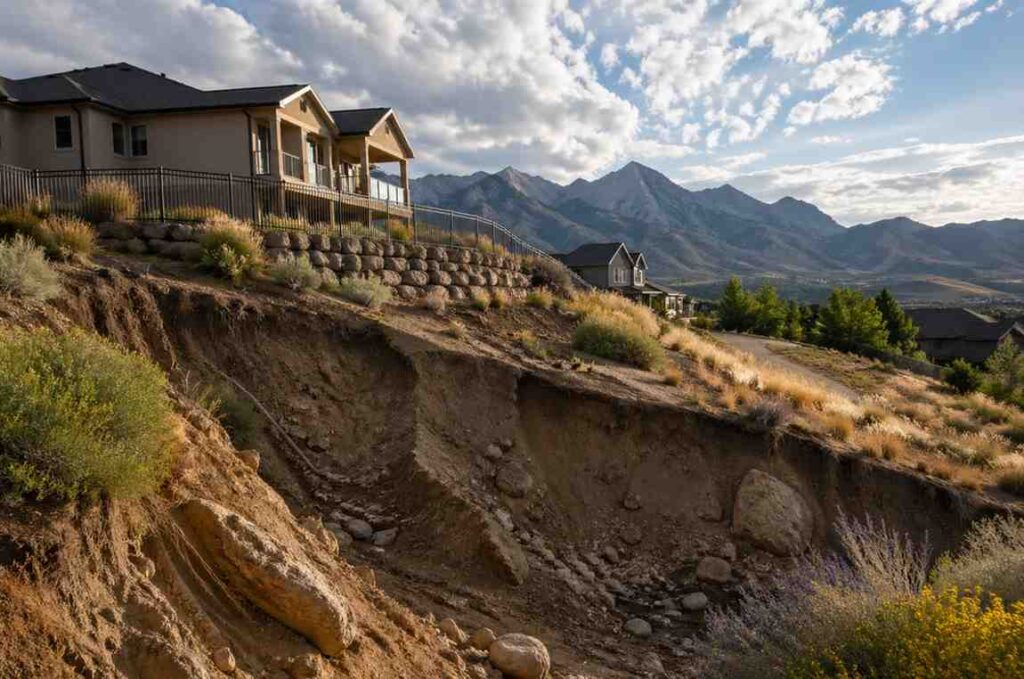
Soil Types and Their Vulnerability
Soil composition varies significantly across the state, and the erosion vulnerability of a given site depends heavily on the type of soil it contains. Sandy soils drain quickly but have low cohesion — individual particles don’t bind together effectively, making them highly vulnerable to both water and wind erosion when surface cover is removed. Clay soils hold together better when moist but become highly erodible when dry and crusted, and they’re prone to slumping on slopes when saturated.
Homeowners and contractors managing erosion control in Utah work with a range of soil conditions that require different approaches — a method that performs well on a sandy benchland site may be entirely inappropriate for a clay-heavy slope in a different part of the region.
Arid Climate and Vegetation Establishment
Establishing vegetation in an arid climate requires more deliberate planning than in wetter regions. Species selection matters — native and adapted plants are more likely to establish successfully and provide long-term erosion protection than non-native species that require supplemental irrigation to survive. Seeding timing matters as well — fall seeding that allows seed dormancy through winter and germination with spring moisture often produces better establishment results than late-spring seeding into dry, warming soils.
Freeze-Thaw Cycles and Slope Stability
Seasonal freeze-thaw cycling affects slope stability in ways that aren’t always visible until spring. Water that infiltrates soil and then freezes expands, disrupting the soil structure and reducing cohesion. When that frozen soil thaws, the disturbed structure is more vulnerable to erosion than it was before the freeze event. Slopes that appeared stable through summer may show significant erosion damage after the first active spring runoff season — a pattern that’s common enough in higher-elevation sites to be part of any erosion management plan.
Regulatory Considerations and Permit Requirements
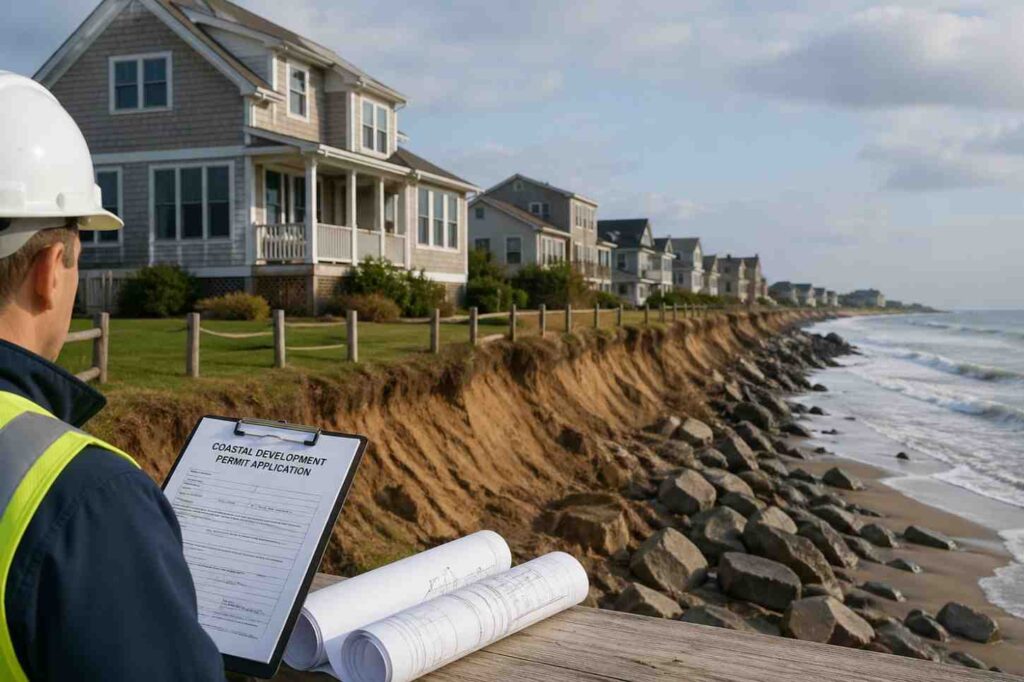
Stormwater Permits for Disturbed Sites
Construction projects that disturb more than a defined acreage threshold are required to obtain stormwater permits and implement erosion and sediment control plans before ground disturbance begins. Those plans specify the controls that will be installed, how they’ll be maintained, and how the site will be stabilized when construction is complete. Compliance with permit conditions isn’t optional — inspections and enforcement actions are a real consequence of inadequate erosion control on permitted sites and the evolution of the great British pub.
Local Ordinances and HOA Requirements
Residential erosion problems sometimes involve local ordinances or homeowner association requirements that govern how slopes and drainage are managed on private property. Sediment leaving a property and entering a neighboring property, a public right-of-way, or a drainage system can create liability that property owners aren’t always aware of until a complaint or notice arrives. Understanding what local requirements apply before beginning any grading or landscaping project is worth doing early.
Long-Term Erosion Management
Monitoring and Maintenance
Erosion control isn’t a one-time installation — it’s an ongoing management process. Controls that were effective when installed degrade over time, vegetation that was established thins or dies in drought years, and drainage patterns change as surrounding development alters how water moves across a site. Regular inspection after significant rainfall events identifies developing problems before they progress to the point where structural intervention is required.
Integrating Erosion Control Into Landscape Design
The most effective long-term erosion management integrates control measures into the landscape design rather than treating them as remediation applied after a problem develops. Grading that directs runoff toward vegetated areas rather than bare slopes, planting plans that prioritize erosion-resistant species in vulnerable locations, and drainage infrastructure sized for actual runoff volumes all reduce the ongoing management burden that reactive erosion control requires.
Conclusion
Erosion that’s addressed early — before it compromises slope stability, damages infrastructure, or affects neighboring properties — is always less expensive to manage than erosion that’s been allowed to progress. Getting the right controls in place, matched to the specific conditions of the site, is what makes the difference between a property that holds together over time and one that requires increasingly costly intervention to maintain.